TL;DR: UPDATED SEPTEMBER 8, 2026
On December 11, 2026 (moved from November 12 by H.R. 6500, signed September 2, 2026), federal law H.R. 5371 takes effect and redefines hemp to include a "total THC" standard, effectively reclassifying most current THCA flower, pre-rolls, vapes, and concentrates as controlled substances. Additionally, the law caps finished hemp products at 0.4mg total THC per container, which would end the current Delta 9 gummy and beverage market at today's dosing levels.
UPDATE: September 8, 2026: On September 2, 2026, President Trump signed H.R. 6500 into law. The federal total-THC rule and the 0.4 mg per container cap now take effect December 11, 2026 for naturally occurring cannabinoids (THCA flower, hemp Delta-9, CBD). Synthetic and converted cannabinoids such as Delta-8, HHC and THC-O still lose hemp status on November 12, 2026. State dates (Texas, Illinois, Philadelphia) do not move. Full breakdown: Hemp Ban Delay Signed Into Law: What Changes and What Doesn't.
Last updated: September 8, 2026.
Quick answer: On December 11, 2026 (November 12 for synthetic cannabinoids), federal law H.R. 5371 takes effect and redefines hemp to include a "total THC" standard, effectively reclassifying most current THCA flower, pre-rolls, vapes, and concentrates as controlled substances. Additionally, the law caps finished hemp products at 0.4mg total THC per container, which would end the current Delta 9 gummy and beverage market at today's dosing levels. There are legislative efforts to delay or repeal these provisions, but as of April 2026, those efforts are stalled and the deadline is expected to take effect as written. For hemp consumers, the practical implication is clear: the next ~7 months are the last broad window to buy current-formulation THCA and high-dose Delta 9 products. This guide explains what's changing, what has the longest runway, and how to stock up smart.
What Is H.R. 5371 and Why Does November 12, 2026 Matter?
H.R. 5371, formally titled the Continuing Appropriations, Agriculture, Legislative Branch, Military Construction and Veterans Affairs, and Extensions Act, 2026, was signed into law on November 12, 2025 by President Trump. It was primarily a continuing resolution to end a 44-day government shutdown. Embedded within it was Section 781: a provision that fundamentally rewrites the federal definition of hemp.
The changes in Section 781 take effect 365 days after enactment, which means November 12, 2026. On that date, three core changes to federal hemp law become enforceable:
1. Total THC replaces Delta-9 THC as the controlling standard. The 2018 Farm Bill defined hemp as cannabis with less than 0.3% Delta-9 THC by dry weight. H.R. 5371 replaces this with a "total tetrahydrocannabinol" concentration standard that includes THCA in the calculation (via a post-decarboxylation formula: THCA x 0.877 + Delta-9 THC). Under this standard, any flower with meaningful THCA content fails federal compliance.
2. A 0.4mg per container limit on finished hemp-derived cannabinoid products. This is the provision that affects Delta 9 gummies, beverages, tinctures, and other edible products. No final hemp-derived product can contain more than 0.4mg of total THC per container. Most current Delta 9 gummies contain 5-25mg per serving, far above this limit.
3. Exclusion of synthetic cannabinoids. No cannabinoid produced through chemical synthesis outside the Cannabis sativa L. plant is included in the hemp definition. This targets Delta-8 THC, Delta-10 THC, HHC, and other "converted" cannabinoids.
The result: industry groups estimate approximately 95% of existing hemp-derived cannabinoid products will become non-compliant once the law takes effect.
Will the November 2026 Deadline Actually Take Effect?
As of April 2026, yes, though legislative efforts to delay or modify the provisions continue.
Several bills have been introduced that would address the deadline:
- H.R. 6209 (Mace/Massie Bill): Introduced November 2025. Would repeal the hemp provisions in H.R. 5371 entirely and restore the 2018 Farm Bill framework.
- The HEMP Act (H.R. 1287): Bipartisan bill introduced January 2026. Would establish a federal regulatory framework for hemp-derived cannabinoids instead of banning them.
- Hemp Planting Predictability Act: Would delay the H.R. 5371 hemp provisions from November 2026 to November 2028.
- Farm Bill amendments: Industry stakeholders pushed for delay language to be attached to the 2026 Farm Bill. However, on March 5, 2026, two amendments filed by Rep. Jim Baird (R-IN) were ruled "not germane" by House Agriculture Committee Chairman GT Thompson and were never voted on.
The procedural reality is that the Agriculture Committee has signaled it doesn't consider consumable hemp products within its jurisdiction. Without a must-pass legislative vehicle, the delay bills face a steep climb. Additionally, 2026 is a midterm election year, with federal elections on November 5, 2026, exactly one week before the H.R. 5371 hemp provisions take effect. That timing creates political pressure in both directions, but doesn't guarantee congressional action.
For now, the working assumption for hemp buyers and businesses should be: the November 12, 2026 deadline will take effect as written.
What Specifically Will Be Banned on November 12, 2026?
Under H.R. 5371 as written, the following products will no longer qualify as federally legal hemp:
THCA flower. Any flower with meaningful THCA content (which is essentially all THCA flower at saleable potencies) exceeds the total-THC threshold.
THCA pre-rolls and blunts. Same logic as flower, the THCA content would push total THC over the limit.
THCA concentrates. Live rosin, live badder, bubble hash, diamonds, and other high-potency concentrates would all exceed the standard.
THCA and live resin vapes. Vape cartridges and disposables exceed the per-container limit.
Current-dose Delta 9 gummies, beverages, and tinctures. The 0.4mg per container limit would require major reformulation. A single 10mg gummy in a 10-count package would contain 100mg per container, 250x the limit.
Delta-8, Delta-10, HHC products. Synthetic cannabinoid exclusion would eliminate these categories entirely.
What Will Still Be Legal After November 12, 2026?
Some hemp categories survive the transition:
CBD products. Broad-spectrum and isolate CBD products with very low or zero THC remain compliant.
Very-low-dose Delta 9 products. Beverages or edibles formulated to contain under 0.4mg per container could remain legal. This represents a significant downward shift in dosing but is not zero.
Industrial hemp. Fiber, grain, and seed uses remain fully legal and are not affected by the cannabinoid-focused changes.
State-licensed cannabis products. In states with legal medical or recreational cannabis programs, those markets continue operating under state law and are unaffected by the federal hemp redefinition.
What Should I Actually Stock Up On?
If you're going to stock up, here's how to think about prioritization by product category:
Priority 1: THCA Flower and Pre-Rolls (Highest Urgency)
THCA flower has the shortest legal runway and the most dramatic regulatory cliff. Once the federal deadline hits, there is no obvious path for THCA flower to continue existing in the legal hemp market at current potencies. If you consume flower regularly and want to stock up on any single category, this is it.
What to buy:
- THCA flower in your preferred strains
- THCA pre-rolls, mini pre-rolls, and blunts
- Premium hash hole pre-rolls
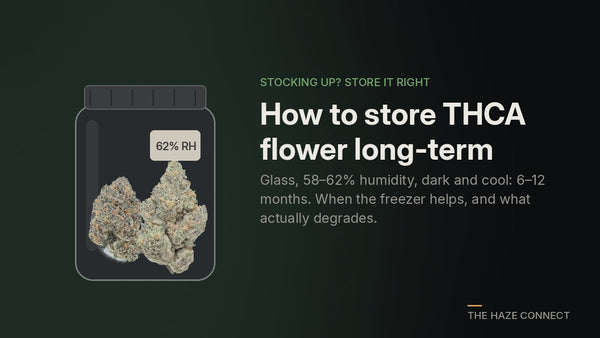
Storage note: properly stored flower (airtight glass, cool, dark, 58-62% RH with humidity packs) retains potency and flavor for up to a year. For longer storage, vacuum-sealed flower in the refrigerator or freezer can last 18-24 months.
Priority 2: THCA Concentrates (High Urgency)
Concentrates have a similar regulatory cliff to flower, but store longer and take up less space. Pound-for-pound, concentrates are the most efficient stock-up category.
What to buy:
- THCa Live Rosin, highest purity, longest shelf life
- THCa Live Badder, accessible entry point
- Live resin disposable vapes, premium format, travel-friendly
Storage note: concentrates last 12-24+ months in airtight containers in cool, dark conditions. Refrigeration extends this further. Let refrigerated concentrates return to room temperature before opening.
Priority 3: Delta 9 Products at Current Dosing (Medium Urgency)
Delta 9 gummies and beverages at current dosing will be restricted on November 12. The category won't disappear entirely, lower-dose products will continue, but the 5mg, 25mg dosing that most consumers prefer will not be federally legal at retail.
What to buy:
- Delta 9 gummies in your preferred dose and flavor
- 5mg THC Seltzer and other beverage formats
Storage note: gummies stored in airtight containers in cool, dark conditions maintain potency for 12-18 months past manufacturing date. Beverages have shorter shelf lives (typically 6-12 months), check expiration dates.
How Much Should I Buy?
The right quantity depends on your consumption pattern. A rough framework:
Regular consumer (one session per week): 28g of flower or 2g of concentrate or 100mg of edibles per month x 7 months remaining = ~200g flower / ~14g concentrate / ~700mg edibles.
Frequent consumer (multiple sessions per week): 56-112g flower / 4-8g concentrate / 200-400mg edibles per month. Multiply by 7 months = meaningful stockpile.
Daily consumer: Storage limits become the constraint, not budget. Focus on concentrates and gummies, which are more space-efficient and longer-lasting than flower.
Don't buy dramatically more than you'd realistically consume in 12-18 months. Even properly stored flower eventually degrades, and fresh product in a different regulatory environment is a better default than stockpiling more than you can use.
What About the Texas Situation: Does That Change the Stock-Up Math?
The Texas DSHS rules were paused by a Travis County court in April 2026, but the Fifteenth Court of Appeals lifted that injunction on June 5, 2026, and on July 31 Texas also scheduled delta-8 and other isomers. High-THCA products are not compliant in Texas today; hemp Delta-9 at or below 0.3% still is.
Even if the pending Texas appeals succeed, the federal December 11, 2026 deadline is unaffected. Texas consumers face the same federal cutoff as everyone else.
For the current Texas legal situation, see Can You Still Ship THCA to Texas in 2026?.
What's the Legal Status Between Now and November 2026?
Between April 20, 2026 and November 12, 2026, federal law remains the 2018 Farm Bill standard: hemp is legal with less than 0.3% Delta-9 THC by dry weight. THCA flower, pre-rolls, vapes, concentrates, and Delta 9 gummies at current dosing are all federally legal.
State laws vary. A few states have already banned THCA or smokable hemp. The Texas situation is unique, an active TRO pauses the state's own attempted ban pending the April 23 hearing. For current state-by-state status, check our legality guide.
What Happens to Hemp Businesses After November 12, 2026?
The industry faces a significant restructuring. Some paths forward:
State-licensed cannabis. Some hemp businesses will pivot to become state-licensed marijuana operators in states where that's possible.
Low-dose products. Some brands will reformulate to produce compliant low-dose products that fit within the 0.4mg per container limit.
CBD focus. Existing hemp businesses may pivot back toward CBD, which remains fully legal.
Closure. Industry estimates suggest 40,000+ Texas workers and 6,300+ Texas businesses alone could be affected. Nationally, around 300,000 jobs are tied to the current hemp economy.
Legal challenges. Constitutional challenges to Section 781 are possible, though the legal theories are different from state-level challenges.
Frequently Asked Questions
When exactly does the federal hemp ban take effect?
December 11, 2026 for naturally occurring cannabinoids such as THCA and hemp Delta-9. The original date was November 12, 2026, one year after H.R. 5371 was signed; H.R. 6500, signed September 2, 2026, moved it by 29 days. Synthetic cannabinoids still lose hemp status on November 12, 2026.
Will THCA be illegal everywhere in the U.S. after November 2026?
THCA flower and concentrates at current potencies will no longer qualify as federally legal hemp. Some states may continue to permit THCA under state law, but federal law overrides permissive state frameworks on the cannabinoid definition. In practical terms: interstate commerce in THCA flower will stop, mail carriers will no longer ship it, and the current national retail market will end.
Are there any efforts to stop or delay the November 2026 deadline?
Yes. Several bills have been introduced (H.R. 6209, The HEMP Act, Hemp Planting Predictability Act), but none has passed committee as of April 2026. Farm Bill amendments to delay the deadline were ruled "not germane" in March and not voted on. The legislative path to delay is narrow and running out of time.
Can I still legally buy THCA products right now?
Yes. Until November 12, 2026, THCA products that comply with the 2018 Farm Bill (less than 0.3% Delta-9 THC by dry weight) remain federally legal. Texas specifically has an active TRO pausing its state-level ban. See our Texas update for current state status.
What's the longest-runway hemp product I can stock up on?
Delta 9 gummies and beverages at low doses have the longest viable runway, they're the most likely category to survive the November 2026 deadline in some reformulated form. For pure unchanged product, concentrates store the longest (12-24+ months) and are the most space-efficient stockpile.
Is it legal to stockpile hemp products for personal use?
Under current federal law, yes. Purchasing Farm Bill-compliant products in any quantity for personal use is legal. After November 12, 2026, possession rules may vary by state, the federal changes primarily target manufacture, distribution, and retail sale, but states retain authority over possession.
Should I be worried about the legality of products I already own?
Products purchased before November 12, 2026 under the existing federal framework were lawfully acquired. The federal changes primarily affect forward-going commerce. As always, state possession laws vary, if you live in a state with strict marijuana laws, the reclassification of certain cannabinoids under federal law could affect how state law treats them.
Where can I buy Farm Bill-compliant hemp products right now?
The Haze Connect ships Farm Bill-compliant hemp products to all states where current law permits. Our full lineup includes THCA flower, pre-rolls and blunts, live resin disposable vapes, concentrates, and Delta 9 gummies and edibles. All products are third-party lab tested with published COAs.
Sources
Primary sources used for the legal status described above. Statutes and agency pages are authoritative; verify current text before relying on it.
- Public Law 119 37 Continuing Appropriations Agriculture Act 2026 with Section 781 hemp redefinition (govinfo)
- Public Law 119 37 full text HTML (govinfo)
- H.R. 6500 enrolled bill text (govinfo)
- 7 U.S.C. 1639o hemp definition (Cornell LII)
- Hemp ban delay passes Congress heads to Trump desk Sep 2 2026 (Marijuana Moment)