Updated November 13, 2026. The first phase of the federal hemp redefinition took effect yesterday. We will update this page as the FDA, DEA, Congress and the courts act.
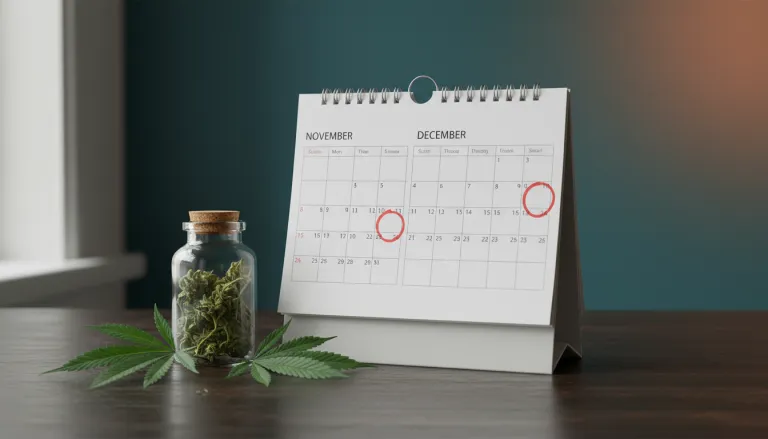
Is THC-P legal? As of November 13, 2026, the honest answer is "barely, and not for long." The new federal hemp law strips hemp status from synthetic and lab-converted cannabinoids in two steps. The first step hit on November 12, 2026. The second lands on December 11, 2026. Which step catches THC-P, THC-O, HHC, delta-8 and the rest depends on one question the law asks about each molecule: can the cannabis plant make it on its own? Below is the plain-language breakdown, cannabinoid by cannabinoid, with the sources.
Key takeaways
- November 12, 2026 (already in effect): products containing cannabinoids the cannabis plant is not capable of producing naturally lost federal hemp status. THC-O is the clearest example.
- December 11, 2026: products containing cannabinoids that occur naturally but were synthesized or manufactured outside the plant lose hemp status. That is where commercial THC-P, converted delta-8 and delta-10 most likely land.
- THC-P is a naturally occurring cannabinoid (Italian researchers isolated it from cannabis in 2019), but nearly all THC-P on the market is made in a lab from CBD. That puts it in the December 11 bucket on the statute's text, with real risk that regulators read it more aggressively.
- HHC is already Schedule I in DEA's view. DEA gave HHC its own Schedule I drug code effective May 4, 2026. Court challenges are pending.
- The FDA still has not published the cannabinoid list Congress ordered, so there is no official federal list of which compounds are "naturally produced." Expect disagreement and uneven enforcement.
- After December 11 there is no federal path left for THC-P as hemp, whichever bucket it falls in. Several states, including Texas and Illinois, already ban it by name.
What the new federal law actually says
The hemp language sits in Section 781 of Public Law 119-37, the funding bill President Trump signed on November 12, 2025. It rewrote the federal definition of hemp that the 2018 Farm Bill created. Under the new definition, the following are no longer "hemp":
- Hemp-derived cannabinoid products containing cannabinoids that are not capable of being naturally produced by the cannabis plant.
- Products containing cannabinoids that can be naturally produced but were synthesized or manufactured outside the plant.
- Intermediate products with more than 0.3% total THC (THCA included) and other cannabinoids with similar effects.
- Final consumer products with more than 0.4 milligrams combined total THC and similar-effect cannabinoids per container.
Read together, those four exclusions end the "converted cannabinoid" business that grew up after 2018. Making delta-8 from CBD, adding an acetate group to make THC-O, hydrogenating THC into HHC or building a longer side chain to make THC-P: every one of those processes happens outside the plant, and every product that results is caught by at least one exclusion.
Why there are two dates: November 12 vs December 11
The original effective date for everything was November 12, 2026. In September, Congress passed a stopgap funding bill, H.R. 6500 (now Public Law 119-103), and the President signed it on September 2, 2026. Section 2019 of that law pushed most of the hemp redefinition to December 11, 2026, the same day that stopgap funding runs out.
It did not push everything. The Congressional Research Service explained the split in an October 28, 2026 legal sidebar (LSB11496): the delay "allows certain provisions of the new hemp definition to go into effect as planned on November 12, 2026," namely the provisions that exclude products containing cannabinoids not capable of being naturally produced by the cannabis plant. The separate exclusion for naturally occurring cannabinoids that were synthesized or manufactured outside the plant waits until December 11, along with total THC and the 0.4 mg per container cap. Hemp attorney Rod Kight reads Section 2019 the same way.
A correction to a common mistake. When the delay passed, much of the coverage, including some earlier articles on this site, described the split as "natural cannabinoids get a delay, synthetic cannabinoids do not," and put converted delta-8 on November 12. That is not what Section 2019 says. The test is about the molecule, not the manufacturing method. A cannabinoid the plant can make, such as delta-8, sits in the December 11 group even when a factory made it from CBD. Only molecules the plant cannot make at all were cut off on November 12.
Cannabinoid by cannabinoid: which date applies
The table below is our best reading of the statute and the CRS analysis as of November 13, 2026. Because the FDA has not published its list of naturally produced cannabinoids, the middle rows are judgment calls, not settled law.
| Cannabinoid | Made by the plant? | How retail product is usually made | Federal hemp status ends |
|---|---|---|---|
| THC-O (THC-O acetate) | No | CBD converted to delta-8, then reacted with acetic anhydride | November 12, 2026 |
| THC-P (THCP) | Yes, in trace amounts | Synthesized from CBD | December 11, 2026 on the text; some firms treat it as November 12 |
| HHC | Disputed | Hydrogenation of THC or CBD-derived THC | DEA already treats it as Schedule I; November 12 at the latest if found non-natural |
| HHC-P, THC-JD, THC-H, THC-B and other "exotic" homologs | Ranges from reported in trace amounts to not established | Lab synthesis | November 12 or December 11, molecule by molecule; no official list |
| Delta-8 THC | Yes, in trace amounts | Converted from CBD | December 11, 2026 |
| Delta-10 THC | Reported in trace amounts | Converted from CBD | Most likely December 11, 2026 |
| THCV | Yes | Extracted or converted | December 11 if converted or if it counts toward the 0.4 mg cap |
| THCA | Yes (the main acid in raw flower) | Grown in the plant | December 11, 2026 (total THC rule) |
The THC-P problem, explained
THC-P, short for tetrahydrocannabiphorol, is a real plant compound. A team led by Cinzia Citti identified it in a medical cannabis variety and published the finding in Scientific Reports at the end of 2019. In lab binding studies, THC-P attached to the CB1 receptor far more strongly than delta-9 THC, which is where the "many times stronger than THC" marketing came from. That is a test-tube binding result, not a human potency measurement, but it explains why THC-P carts and gummies hit the way they do.
The catch is quantity. The plant makes so little THC-P that nobody extracts it commercially. Retail THC-P is synthesized, usually starting from hemp CBD. So THC-P is a cannabinoid that is capable of being naturally produced, made outside the plant. On the text of Section 781 and Section 2019, that is the December 11 exclusion, not the November 12 one.
Not everyone reads it that way. Some law firms and retailers grouped THC-P with THC-O and HHC as a November 12 "synthetic," and without the FDA's list, nobody can point to an official answer. A regulator who wants to argue that commercial THC-P is chemically distinct from the trace compound in the plant has room to try. If you are a retailer, the practical question is not whether THC-P dies on November 12 or December 11. It is whether you want to be holding it when the window closes four weeks from now.
THC-O: the clearest November 12 case
THC-O does not occur in cannabis. CRS describes it as being produced by converting CBD to delta-8 THC and then adding acetic anhydride. DEA said as much in a February 13, 2023 letter, concluding that delta-8 and delta-9 THC-O are Schedule I because they can only be obtained synthetically. The Fourth Circuit disagreed under the old 2018 definition in Anderson v. Diamondback Investment Group (September 4, 2024), and CRS notes that the two positions contradict each other. The new statute settles the hemp question going forward: a product containing a cannabinoid the plant cannot make is not hemp, as of November 12, 2026.
HHC: already Schedule I in DEA's eyes
On May 4, 2026, DEA published a final rule giving hexahydrocannabinol (HHC) its own Schedule I listing and drug code (7220). DEA's position is that HHC was always a Schedule I tetrahydrocannabinol and that the rule "makes no substantive" change; it simply names the compound. Hemp companies have petitioned the Fourth and Ninth Circuits to overturn the rule, and those cases are still pending. Whether HHC is "capable of being naturally produced" by the plant is disputed, so it may have lost hemp status on November 12. Either way, DEA does not treat it as hemp today.
Delta-8 and delta-10: the December 11 group
Delta-8 THC occurs naturally in cannabis in small amounts, and CRS treats it that way. Commercial delta-8 is made from CBD, so it falls under the "naturally producible but manufactured outside the plant" exclusion, which takes effect December 11. Converted delta-10 is most likely in the same group. Delta-8 products also fail the 0.4 mg per container cap on December 11, because the cap counts any cannabinoid with THC-like effects, not just delta-9. For a deeper look at the delta-9 math, see why delta-9 THC is legal under the 0.3% rule.
What "losing hemp status" means legally
Hemp is carved out of the Controlled Substances Act. A product that falls outside the hemp definition loses that carve-out. According to CRS, these products are then treated as controlled substances to the extent they fall within the CSA's definition of marijuana or tetrahydrocannabinols, which are generally Schedule I. In practice that means:
- No federal sell-through period. The law does not give existing inventory a grace window.
- Banking, payments and shipping get harder first. Processors, insurers and marketplaces tend to react before police do. DEA's separate HHC listing gave them a ready-made reason.
- Enforcement is likely to be uneven. Federal agencies have not announced a crackdown plan, and the missing FDA list makes some cases hard to prove. That is a description of the risk, not a reason to ignore it.
- State law can bite sooner and harder. See the next section.
States that already ban THC-P and other converted cannabinoids
- Texas: Since July 31, 2026, delta-8, delta-10, delta-6, THCP and other non-delta-9 THC isomers made by converting CBD are Schedule I controlled substances under Texas law, with only trace, naturally occurring amounts in compliant hemp exempt. See what is still legal in Texas.
- Illinois: Since November 12, 2026, a consumer hemp product cannot contain synthetic cannabinoids or naturally occurring cannabinoids synthesized outside the plant, and the 0.4 mg per container limit counts delta-8, THC-P, HHC and THC-O. See our Illinois hemp ban lawsuit update.
- Missouri: HB 2641 took effect November 12, 2026 for most intoxicating hemp products (hemp THC beverages may be sold until December 11). Over-limit products can be sold only through licensed marijuana businesses, and a federal judge dismissed the industry's challenge to the law on November 4.
- Oklahoma: SB 1257, effective November 1, 2026, moved THC to Schedule I under state law and expressly covers chemically synthesized THC compounds, including those derived from industrial hemp.
That list is not complete. Our state-by-state deadline guide covers the rest.
Could Congress still change this?
Not for November 12, which has passed. For December 11, possibly, but nothing has moved. December 11 is also when federal funding runs out, so the next funding bill is the most realistic vehicle for any change. Some bills would repeal the changes outright (H.R. 6209) or delay the whole new definition by two years (H.R. 7024, H.R. 7010 and S. 3686). Others, such as H.R. 9830, would replace the ban with a regulated market. None has received a vote. A repeal or a two-year delay would keep THC-P inside the hemp definition for now, but nothing suggests one is close. Our hemp ban countdown tracks the latest.
What to do if you buy or sell THC-P, THC-O or HHC
- Stop buying THC-O inventory. It is outside the hemp definition now.
- Treat THC-P and HHC as gone. Even on the most favorable reading, THC-P has four weeks left federally, and HHC already has a DEA Schedule I code.
- Read the full COA panel, not just delta-9. Many potency panels only test delta-9, THCA and a few majors. If a product's label lists a converted cannabinoid the COA does not quantify, that is a red flag. Our lab results page shows what a full panel looks like.
- Check your state first. Texas, Illinois and several other states already ban these compounds, regardless of the federal dates.
- Plan for December 11 for everything else. Naturally occurring THCA flower stays inside the current federal definition until December 11, 2026, subject to state law. See is THCA still legal and where THCA flower is still legal.
FAQ
Is THCP legal in 2026?
Federally, commercial THC-P most likely remains inside the hemp definition until December 11, 2026, because THC-P occurs naturally in cannabis and the exclusion for naturally occurring cannabinoids made outside the plant was delayed to that date. Some firms read it as banned November 12. After December 11 it is excluded either way. Texas and Illinois already ban it under state law.
Is THC-P illegal after November 12, 2026?
Not on the most common reading of the statute. Only cannabinoids the plant cannot naturally produce lost hemp status on November 12. THC-P is naturally produced in trace amounts, so it falls in the December 11 group. Because the FDA has not published its official list, that reading is not guaranteed.
Is THC-O illegal now?
Yes, federally. THC-O does not occur in the cannabis plant, so products containing it lost federal hemp status on November 12, 2026. DEA has considered THC-O a Schedule I substance since at least its February 2023 letter.
Is HHC legal?
DEA says no. It listed HHC in Schedule I with its own drug code effective May 4, 2026, and says HHC was always controlled. Lawsuits challenging that rule are pending in two federal appeals courts. Under the new hemp law, HHC is out by December 11 at the latest.
Was delta-8 banned on November 12?
No. Delta-8 occurs naturally in the plant, so converted delta-8 falls under the exclusion that takes effect December 11, 2026. It also fails the 0.4 mg per container cap that starts the same day. Some states ban it already.
Is THCV synthetic?
No. THCV is a naturally occurring cannabinoid. Whether a THCV product stays hemp after December 11 depends on how it was made and whether it counts toward the 0.4 mg cap as a cannabinoid with THC-like effects, which the FDA was supposed to define.
What happens on December 11, 2026?
The rest of the federal redefinition takes effect: total THC (THCA included) at 0.3% for plants and intermediates, a 0.4 mg per container cap on finished products, and the exclusion for naturally occurring cannabinoids synthesized outside the plant. That combination ends federal hemp status for almost every intoxicating hemp product, THC-P included.
Can I still buy THC-P online?
Some sellers will keep listing it until December 11, and some will keep going after that. Buying it carries more risk every week: state bans, payment processor shutdowns, carrier seizures and, after December 11, federal controlled-substance status. Check your state law before ordering anything.
Why hasn't the FDA published the cannabinoid list?
The law gave the FDA 90 days from November 12, 2025 to publish lists of naturally produced cannabinoids, THC-class cannabinoids, cannabinoids with similar effects, and a definition of "container." As of CRS's October 28, 2026 sidebar, it had published none of them, and we have found no publication since.
Sources
- Congressional Research Service, LSB11496: Delay in Changes to Hemp Definition: Cannabinoids Not Capable of Being Naturally Produced by the Cannabis Plant (Oct 28, 2026)
- Rod Kight: Most of the federal hemp ban delayed until December 11
- Foley Hoag: A Temporary Reprieve for Hemp-THC Products (Sep 15, 2026)
- Federal Register: Specific Listing for Hexahydrocannabinol, A Currently Controlled Schedule I Substance (May 4, 2026)
- Citti et al., Scientific Reports (2019): discovery of THC-P in cannabis
- UNC School of Government: The Fourth Circuit Weighs in on THC-O and "Synthetic" THC
- Clark Hill: Texas hemp THC crackdown is now in effect
- Illinois Department of Revenue, Informational Bulletin FY 2027-04: Hemp Product Changes
This article is for general information and is not legal advice. Hemp laws are changing quickly. Check current federal and state law before you buy, and talk to a lawyer about your specific situation. Adults 21+ only.